
 Transaction risk intelligence
 Automated supplier statement reconciliation
 Supplier risk intelligence
 Managed AP recovery audit
 Supplier file performance review
 Forensic risk analysis
 Consulting and bespoke reporting








Everything you need to know about Accounts Payable audits.
This guide for finance leaders and AP managers covers the benefits of conducting audits and how to do so effectively, what to expect from external auditors, and steps to take after completion.

Overpayments and the need for audits.
Did you know that overpayments can account for an average of 0.1% of an organisation’s total spend? While this might seem like a small fraction, it can translate into significant amounts when considering that companies can spend millions, even billions, annually.
Recovering overpayments is therefore crucial for enhancing working capital, and investigating is essential to prevent further overspend. This is where the recovery audit comes into play, evolving into a fundamental component of today’s Accounts Payable function.
Key benefits:

Prevent overpayment with error and duplicate detection.

Identify and prevent potential internal and external fraud

Reconcile more supplier statements more often to recover more cash

Optimise working capital by finding historical overpayments
Customer success stories& testimonials.
Read our blog
You see what nobody else sees
What is an Accounts Payable recovery audit?
An accounts payable (AP) recovery audit is a thorough review of transactions and supplier data in an organisation’s AP records. This is completed internally or by an external auditor.
A thorough accounts payable audit identifies overpayments, duplicate payments, fraud, untaken credits, and unrecorded liabilities. If these problems go unnoticed, they cause issues with working capital, forecasting and budgeting, ultimately impacting your operations and bottom line.
Why do AP teams conduct recovery audits?
The aim of an AP audit is to recover cash that has circumvented your financial controls, to protect your bottom line and support cash flow. It is an opportunity to evaluate and strengthen your controls and streamline processes. It also ensures compliance with regulations, internal procedures and supplier contracts or agreements, and can even alert you to potential fraud.
How often should you conduct Accounts Payable audits?
We recommend completing an accounts payable audit annually, especially before any major changes to your payables process, such as a change of ERP and process or departmental restructuring. Sometimes it is not realistic to complete regular audits, but it’s good practice to have an external audit at least every 3 years.
However, if your goals are to increase ledger accuracy and compliance year-round, we recommend checking your transactions and suppliers every day using an automated tool.


What’s the difference? Internal, external and recovery audits.
External audits
An external audit is an independent review of an organisation’s financial records, assessing compliance and accuracy. The audit is completed for a specific predetermined financial period. Many public organisations are required to complete an audit, where the scope will depend on many factors, including the size the organisation.
Internal audits
Internal audits, however, are completed by the company’s own AP employees or internal audit department. Typically, they encompass a company’s operations and processes. They evaluate the effectiveness of internal controls and policy compliance, while identifying risks and improvement opportunities. It is best practice to complete internal audits regularly, at least annually, if not more often for new or changing processes.
Recovery audits
A recovery audit sets out to review transactions specifically with a focus on cash recovery. The cash recoveries will usually come from overpayments or duplicate payments, missing credits or supplier discounts. The AP audit can encompass a wider range of factors, including recovery, supplier errors and compliance issues.
Steps to complete an external accounts payable audit
Completing an audit is not an easy job, and many AP teams don’t have the time, staff or technological resources to deal with a large-scale internal audit. AP teams have many controls in place, but often outsourced to cover the excess workload of an audit.
Completing an external audit
We talked to our recovery audit team here at FISCAL to give us the full overview of their process for an external audit:
Kick-off meeting to align resources
We begin by gathering key stakeholders in the process, so everyone is clear on the needs and objectives of the project. This should include members of IT, AP and potentially procurement.
Data extract and software setup.
For most external audits, your IT team will need to do some work behind the scenes to enable data access. Once this is complete, a data extract will take place and the software, if appropriate to your auditor, is set up. Often, auditors will give guidelines to support your IT team, so this can happen quickly and easily. In the meantime, our team walk our clients through the process, explaining what we look for and how it works.
Audit project goes live
Your consultant conducts the audit by using specialist tools, for example, we run the data through our FISCAL software.
Supplier statement review: The first place we look for discrepancies is in supplier statements. We create a prioritised list of suppliers based on their historic value and volume of spend. Then, we request a statement of any open items. It’s here that auditors often find overpayments, unallocated cash and untaken credit notes. As part of the audit, we seek to recover the value back to the bottom line.
Invoice and supplier analysis: We’ll then look at your data using our software, searching for erroneous payments, duplicate payments, overpayments and other issues on an invoice level. Our consultant liaises with your suppliers, following duplicates and overpayments through to resolution. If it is a duplicate, consultant gets this recovered back to the client.
Regular updates: Our consultants give an update weekly, usually via an online call. We keep clients informed on progress and any problems to solve.
Completing the AP audit
Our projects usually run for between 4 and 6 months, dependant on scale. When complete, your auditor gives a report. Our team provide a full report of their findings, cash recoveries and suggestions for improvements going forward to minimise error and cash leakage.
FISCAL TIP:
When outsourcing your AP audit, keep regular contact with your auditors to resolve issues quickly and create a smoother audit process.


Steps to complete an internal accounts payable audit
Internal audits have fewer steps, but here’s what we recommend help you with the process:
Keep the kick-off meeting. Make sure you are clear on what you’re trying to achieve. The job will be far easier to do if all members of staff buy into the process.
Gather your data first, including POs, invoices and supplier statements. Then, work in order of spend value downwards. We’ve found that the majority of your spend lies within in your first 250 of your suppliers, if you categorise by highest spend first. Therefore, completing at least this number of suppliers is paramount. Of course, there are always outliers and exceptions, so ideally, you would want to extend that even further, especially if you have thousands of suppliers.
FISCAL TIP:
If your master supplier file is enormous, conducting an audit will seem like an impossible task. To save time, use an automated system to check your data. We recommend utilising purpose-built risk identification software rather than add-on, or integrated, software for an ERP. The alternative, is, unfortunately rather time-consuming by nature. Long-winded data extraction and Excel pivot table comparisons are incredibly mundane, and fraught with inaccuracies. Why? Because the more human the process, the greater likelihood there is for human error.
Don’t let the findings lie.
Now you’ve tidied up all that data, you don’t want future transactions to become messy again. We recommend that you apply process improvements quickly and regularly check that your staff remain compliant, especially in those first few weeks where they are still getting used to the changes.
Fraud controls and prevention strategies
Audit trails and their importance to AP
As an area of high responsibility, it’s advisable to keep your team accountable and aware of the importance of their actions. An audit trail not only is useful for reverting changes but ensures transparency and process compliance, making audits far easier. A complete audit trail will show who was involved in each part of the payables process, from invoice receipt to payment. It will show any changes to a supplier, transaction or invoice, when the changes were made, and how it was modified.
This will help pinpoint when and how non-compliance and errors occur and help the team to fine-tune processes and keep them watertight.


7 common issues causing problems in your Accounts Payable process
FISCAL have been performing recovery audits since 2007, so we’d like to think we know a thing or two! Here are the most common issues we find in our clients’ Accounts Payable data:
- Duplicate payments, due to:
- Invoice keying error. For example, the letter ‘I’ inputted as a 1, a 0 becomes a letter ‘O’.
- Duplicate invoice entry. Adding a number, letter or special character to the invoice number can cause duplicates.
- OCR scanning error. Software can sometimes misread invoices, resulting in incorrect data.
- Master Supplier File error. These are often separate suppliers that are essentially duplicated but have slight differences.
- Wrong supplier. An invoice can have the wrong supplier attributed to it, such as ones with similar supplier names or numbers as the real supplier.
- Invoices as credit notes. This is commonly seen on statements as an overpayment.
- Invoice date. Some staff often input the date they keyed the invoice into the system rather than the date they were invoiced. US-to-UK date conversion can also be an issue here.
- Wrong values. We tend to see this as numbers the wrong way round – 2008 rather than 2080, or with numbers added or removed in a value.
- Overpayments due to multiple page invoices. This issue commonly occurs when a person inputs the first page value, or subtotal, as opposed to the grand total. If another
Ready to transform your risk controls?
We’d love to talk to you about our software. Book a demo today.

Common problems faced in the audit and how to overcome them
In every audit, whether internal or external, there are a few key sticking points. In our experience, it comes down to people, and time.
Stakeholder collaboration
Getting all stakeholders gathered is extremely important. Not only does it get everyone on the same page and informed of the details, but it also means they can help you troubleshoot any issues immediately. Often, the biggest blocker to a project is people not having the time to talk and think the process over. Therefore, the project struggles to get off the ground.
Supplier engagement
It’s a common issue that suppliers can be slow to reply. As a result, performing the audit becomes more drawn-out, with constant chasing. So, before you do anything, let them know in advance that the audit is happening so they can organise themselves.
Team involvement
Before undertaking any audit, prep your team so they are on board from the get-go. AP staff are often concerned that negative findings will reflect badly on them. Therefore, it’s important to let them know about the measures that might be taken if non-compliance is found and that you will work together to iron out any concerns or errors.
Getting their buy in and involvement throughout the process will ensure a smoother and less stressful accounts payable audit.


The benefits of recovery audit automation software
Increased cost efficiencies and savings
By making the recovery audit process internal, you save by removing any and all costs associated with external auditors. Further, when you make these checks before the payment run by automating the process, the cash does not leave the organisation to begin with. Therefore, you retain as much of your working capital as possible.
Productivity and time gains
That cash benefit is compounded by the time savings being made by your team. With minimal recoveries needed, your accounts payable team can focus on daily tasks and payments, and find time for value added tasks.
Improved ledger and forecasting accuracy
When you complete audits regularly and more easily, and start catching errors before the payment run, your ledger accuracy increases. This allows your organisation to make better data-driven decisions.
Conclusion
An accounts payable audit is a best practice because it ensures the accuracy and integrity of financial transactions. It helps to identify and rectify errors, fraud, and overpayments. This process is invaluable to any organisation. It safeguards the organisation’s financial health, ensures compliance with regulations, and promotes operational efficiency. It also gives peace of mind, as improved ledger accuracy means more precise calculations for investments and other spend.
Applying further preventive measures (such as continuous monitoring) is vital to maintain the integrity of the accounts payable process and prevent future discrepancies. Updating processes often and ensuring compliance is key to maintain these improvements and prevent future issues. By encouraging a collaborative, proactive environment, you can ensure a smoother, more effective accounts payable audit process.

How can FISCAL help?
Our experienced team can help you complete a recovery audit after a long break, facilitate ERP migrations, tidy ledgers before end of year, manage finances from acquisitions or mergers, and more.
Using our risk detection software, our experts perform an audit of the last 2-3 years of your transactional data. They identify and verify duplicates, overpayments and potential occurrences of fraud. Our team then work to recover this from your suppliers on your behalf.
Risk detection software
We recommend using continuous risk detection upon completion of any recovery audit to keep your ledgers accurate and ensure proactive overpayment prevention.
Our platform continuously monitors your transactional data for indicators of fraud, errors and duplicates. We alert you immediately, so your team can review and resolve any queries before the payment run.

Testimonials

Kings College London: Case Study
Read how a FISCAL recovery audit and statement reconciliation returned £1.85m to Kings College London’s bottom line.

The powerful benefits of accounts payable recovery audit automation
This blog describes how automating controls in Accounts Payable (AP) with specialist software can create fantastic gains for the whole organisation and kick-start overpayment recovery.

3 Steps to Recovery Audit Wins and Long Term Protection of Capital – CPD Accredited
We know finance teams need strong controls around their working capital. This webinar explores all avenues of your next recovery audit.
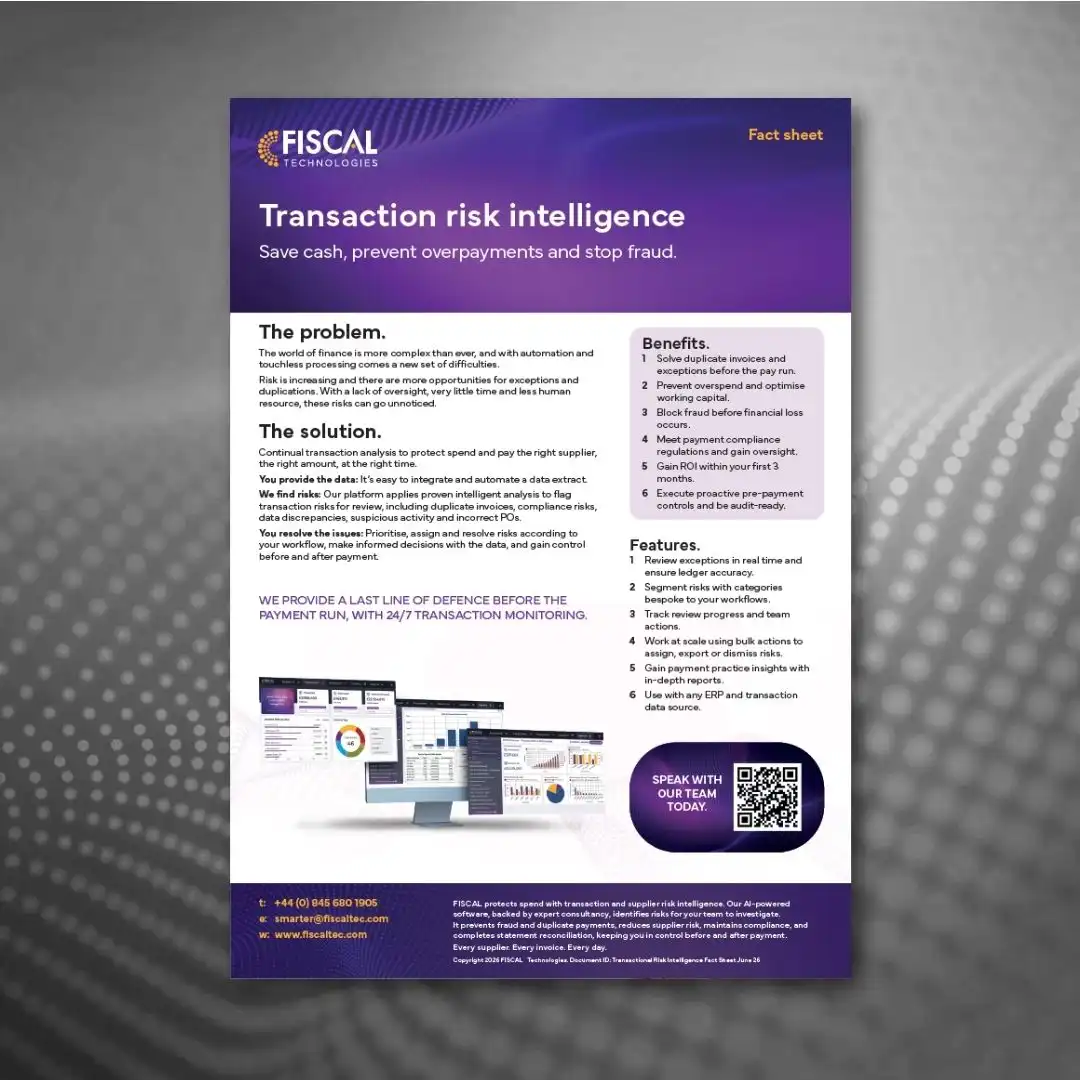
Transaction Risk Intelligence Fact Sheet
Discover how our transaction risk intelligence module works, and helps your team avoid cash leakage and fraud risks.
Want to know more about FISCAL Technologies?
We’d love to show you our solutions in action!