 Transaction risk intelligence
 Automated supplier statement reconciliation
 Supplier risk intelligence
 Managed AP recovery audit
 Supplier file performance review
 Forensic risk analysis
 Consulting and bespoke reporting











This blog discusses master supplier file controls, and how you can overcome operational difficulties to achieve constant supplier file maintenance.
Why the one-time supplier check isn’t working for you
In the beginning, there was supplier screening, and this due diligence during onboarding was necessary to protect your organisation from untrustworthy suppliers. That’s still true today.
But as supplier files grow and duplicates find their way in, as the years pass and suppliers lie dormant, as organisations grow to create subsidiaries or go out of business, havoc begins to reign in the master supplier file. A previously ordered file can quickly become out of control, especially if staff members don’t comply with procedures when updating information or creating a new supplier.
Keeping all this in mind, it may be surprising to learn that only 37% of AP teams perform supplier validations when onboarding only (PPN Supplier Risk Management Report). This opens a huge amount of risk for the organisation, leaving gaps open for payment issues, fraud and legislative incompliance. What would that mean during your next audit?
You think your supplier is clean? It’s just a matter of time.
So, you cleanse your file at the beginning of the year. Great! The issue is that the supplier file will never stay clean. The supplier file is changing constantly, and these risks build up again over time. The hard truth: It needs constant upkeep if you want to ensure smooth operations and lower costs to the business. If you don’t want stress right before the audit, cleansing shouldn’t come yearly, quarterly, or monthly, but daily – continuously.
Think of continuous monitoring like locking your doors at night. It doesn’t matter how secure your home was yesterday if the door is wide open today.
Yet we know that completing even rudimentary checks daily on all your suppliers is a monumental task. For something like credit monitoring, you need to manually enter your supplier into a database to check them. Even doing this 100 times is a drain on staff time that many can’t afford, never mind the thousands of suppliers for a large organisation. Or is it?
The case for automated supplier monitoring
Like with many of our daily problems, many are turning to automation and AI for their solution. Specialised software picks up the slack and automatically searches your supplier file for risks.
This ensures that none of your staff are wasting time searching databases, trying to find suppliers that might be duplicated, or hunting down dormant ones. Nor is this an ad hoc issue that needs to be solved quickly because an invoice is due. Supplier checking simply becomes a small task at the beginning of the day which is only necessary when there’s an issue to be dealt with.
Why more robust measures make sense
It’s not enough for large organisations to maintain rudimentary checks. The PPN report states that ‘the three checks most frequently carried out are the same basic controls that have been in place for decades’: Bank detail changes, VAT verification, and credit checks. While useful, these are surface-level controls that only show part of the supply chain risk picture. It is the tip of the iceberg when it comes to the myriad risks of the supplier file.
With so many suppliers on file, the likelihood of fraud and compliance issues increases. It only takes paying one sanctioned supplier to be slapped with a fine, one duplicated supplier with altered bank details to create a fake invoice. If that can be avoided, why wouldn’t you monitor for it?
There are more than just supplier cleansing risks
Picture this: A supplier with a decent track record suddenly shows up in a headline about bribery charges. Or their credit rating crashes overnight. With continuous monitoring, that’s not a problem you find out after you’ve paid them.
Sometimes a simple cleanse won’t cut it – instead start controlling all the variables. While monitoring the supplier file for dormancy, duplicates, completeness, and correctness, look for other risk indicators:
Compliance failures
Real-time monitoring flags suppliers who may pose compliance risks, including those on sanctions lists and politically exposed person lists. It helps you avoid the legal, financial, and reputational fallout of paying sanctioned entities.
Early warnings of supply chain disruption
Monitoring provides early warning signals that help you act before disruption affects your operations or income.
From unethical practices to angry customers, and data breaches to scandals, a negative news story might signal worse things to come for a company. Monitoring for adverse media means you’re not blindsided by headlines involving your suppliers. You can respond quickly, reassess the relationship, and take action to protect your brand if necessary.
A drop in credit score could signal future insolvency or current financial instability. Both could affect their ability to supply. Having this information as early as possible means your organisation can move to negate any supply chain risk with fall-back suppliers if needed.
Internal compliance and fraud indicators
Internal compliance is essential to ensure finance processes flow smoothly. Simply put, without it, your data is messy, so procedure efficiency and accuracy suffer as a result. We recommend having complete audit trails to create easy supplier file change oversight. Monitoring for bank detail and supplier ownership changes, especially unexpected ones, and any correlation between supplier and employee details – you can reverse any unapproved changes quickly and root out conflicts of interest and fraud before they become a problem.
Monitoring suppliers for appearance on your internal on-stop or no-pay lists ensures your team doesn’t accidentally pay a supplier that should have been flagged.
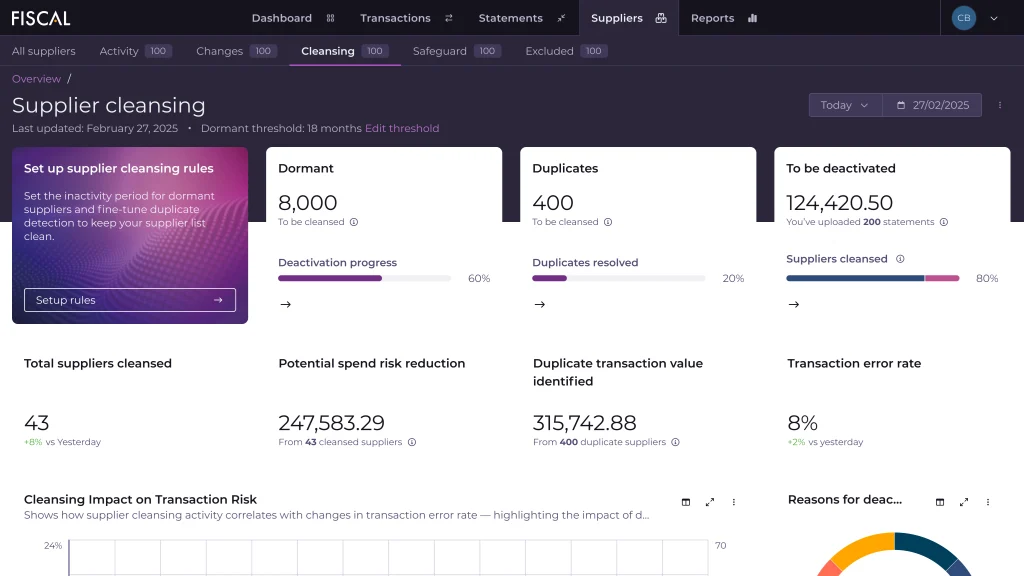
How to spot red flags without lifting a finger
Our software automates finding supplier file issues, creating a fast process for your team. The software finds duplicate and dormant suppliers, supplier file changes, potential fraud risks, sanctioned suppliers, and suppliers with low credit scores or adverse media attention. It turns what could be a time-consuming chore into a straightforward daily task.
This enables you to comply with audit requirements, reduce transaction risk including late payments and overpayments, and pay the right supplier, the right amount, at the right time.
Get proactive about monitoring your master supplier file and reap the benefits
Cleansing your master file shouldn’t be a one-time task, or your organisation is leaving itself open to payment errors, unhappy suppliers, compliance issues, and fraud, which can severely disrupt day-to-day business.
Instead, opt for continuous supplier monitoring to capture key supplier risks. Turn that often-overlooked area into an accurate and compliant supplier file with very little effort.