 Transaction risk intelligence
 Automated supplier statement reconciliation
 Supplier risk intelligence
 Managed AP recovery audit
 Supplier file performance review
 Forensic risk analysis
 Consulting and bespoke reporting











The M&A challenge
Your company is about to embark on a new journey: Merging with or acquiring another entity. It’s an exciting milestone that promises growth, expanded market reach, and new opportunities. But for finance teams like yours, this transformation comes with a critical challenge. You need to protect your spend during what could be a very vulnerable period. What’s at stake? Data integrity is the prime concern because it’s the foundation on which your finance function stands. Dirty data risks incorrect payments, slower processes, working capital leakage, and inaccuracies that affect reporting and forecasting. But with the right planning and controls, you can mitigate those risks. Understanding them is the first step. Let’s explore why M&A creates such a perfect storm for financial vulnerability.
The financial risk landscape of mergers and acquisitions
There’s a unique pressure on finance teams during a transitional period. You need to ensure smooth operations, but you also need to run a large new project. You’ll deal with operational challenges and potential liabilities alike. Research shows that 70-90% of mergers fail to create expected value (Harvard Business Review). Finance integration issues play a significant role:
Managing financial data
According to Mondial Software, 80-90% of all enterprise data post-merger is unstructured and lacks standardised formats. Two sets of differing data creates oversight issues – it’s difficult and time-consuming to combine them without flaws. Those flaws create overpayments, which tie up working capital, potentially for months.
Businesses run their finance operations in different ways. Nowhere is that clearer than when you deal with a new ERP and naming conventions that don’t align with current processes. You may choose to migrate them immediately to your system or use the ‘lift and shift’ approach, copying their current system. Eventually, you will need to merge that data into a single source of truth.
Heightened risk
With more invoices and suppliers, and more confusion within the system, comes greater risk. Periods of change are very much a fraudster’s dream. It is far easier to manipulate an unsure team member, especially if they have a new process to learn. This heightened fraud risk opens you up to possible duplication and overpayment, cascading into significant financial losses if left unchecked.
The five critical risks finance teams face during M&A
To understand where your financial vulnerabilities lie, we need to look at a few key areas in more detail.
Duplicate payments and overpayments
Companies waste between 1%-3% of their budget on duplicate or incorrect invoices (MineralTree). For large companies budgeting upwards of £50 million, that’s at least £500K of lost cash.. Companies report that duplicate billings during acquisition accounted for more than 20% of a supplier’s annual revenue (Eprentise).
- The same suppliers exist in both systems with different identifiers, names, or bank details, creating duplicate suppliers.
- Migration can cause glitches in the system, duplicating invoices across systems with no way to track them.
- Payment timing overlaps create windows for double payment. This is especially relevant if you work on two disconnected systems at the same time.
- Maintaining access to historical data while managing current transactions becomes a critical challenge.
Large-scale change causes confusion and technical difficulties, leading to errors. Sometimes, resource becomes an issue, and controls are not completed. Or, the controls are not adequate for the changes taking place. For example, suppliers submit invoices through multiple channels, making them difficult to trace.
Fraud exposure
Changes to the master supplier file, new suppliers to onboard, increased invoice volumes, changing processes, chaotic communication, changes in authorisation hierarchies, high workload, time pressures. It’s the perfect mixture for a fraudster to take advantage of. There is no doubt that they deliberately target companies going through M&A.
Stricter measures than usual need to be in place in all aspects, including email and telephone. The impact if your fraud controls are not strong enough? Financial losses and potential penalties for non-compliance. This is especially pertinent to larger organisations that need to be compliant with ECCTA legislation.
Master supplier file duplicates
As mentioned earlier, naming conventions differ between companies. It’s not unheard of for merging entities to find they have the same suppliers, especially if they are attempting to decrease competition.
If stored in multiple systems, finding the same supplier under a different name is often the result. And, it’s common for identical suppliers to contain differing information, leading to confusion on which is up-to-date. The problems continue to pile up when supplier files feature dormant suppliers.
Many of these problems stem from a lack of regular cleansing, manual AP processes, and a lack of standardisation. And it leads to late payments as your team search for the correct data. It also could make for complications during audit, and compliance issues to boot.
Compliance and control gaps
A key concern for any finance leader is maintaining compliance to process and regulations. While juggling transactions, staff may find it difficult to maintain their usual standards. The team stretch between ABU and integration work for the period, and timelines compress as they deal with more at once.
New staff, or those moving to a new process, will be unfamiliar with your control framework. Approval processes or authorisation hierarchies can change, and those need to be learnt. You could find challenges with the segregation of duties with overlapping roles or new gaps. Between systems, there may be audit trail inconsistencies.
These issues compound with rushed timelines, differing control cultures, and inadequate change management processes. Non-compliance has the potential to create huge issues. Correctly paying suppliers, regulatory penalties, audit failure, and reputational damage for your organisation.
Your protection strategy
Those were the risks. Now, let’s get on to the good stuff. The first step to protecting spend during a merger or acquisition is careful planning and execution.
Assess
Assess all your current AP policies, procedures, systems, and controls for both organisations. Identify any gaps or difficulties that you might face. Consider: The skills, roles, and responsibilities of each staff member, the strengths and weaknesses in existing software and hardware, compliance measures, transaction and supplier information, records, and reporting methodology. This gives you an idea of how to align organisations and utilise the strongest elements.
Plan
Develop a change management plan based on your assessment. Select a common platform to use, harmonise processes and policies, determine how your team will migrate data, records, and documents from legacy systems to the new system, and organise communications and staff training. Complete a thorough risk review, and document all new processes. If it’s possible, cleanse data before the transitional period to minimise risk.
Monitor
Track risks during migration and transition, for systemic issues and human error. Regularly measure key AP and performance metrics, including those relevant to your risks.
Communicate
Communication and collaboration with all stakeholders is key. Ensure clear communication about new processes and expectations. Check in with your team often and resolve issues with speed. Have staff complete comprehensive training on systems and controls. Define escalation procedures for unusual situations.
The pillars of M&A financial protection
Let’s look at our area of expertise – risk controls.
As with any risk, protection comes down to controls and diligence. During M&A, it’s even more important to enhance standard controls. You need systematic, scalable approaches that work across your systems and maintain effectiveness. You need comprehensive due diligence and regular assessment.
Pillar 1: Continuous transaction monitoring
During mergers and acquisitions, speed is critical. Monitoring invoices before payment catches variations in supplier names, invoice numbers, and amounts before the payment run. It creates higher accuracy. Software that amalgamates the data has the bonus of checking across your systems and enables real-time risk detection. Taking up fewer resources than recovery, this proactive method reduces overspend.
Pillar 2: Comprehensive supplier management
A clean master supplier file is the foundation of correct payments. If both sets of supplier files are correct to begin with, you reduce confusion during transition and reduce duplicates. Going forward, continuous master supplier file monitoring for dormant and duplicate suppliers ensures fewer payment errors and fraud risks.
Pillar 3: Rigorous statement reconciliation
Statement Reconciliation ensures ledgers are accurate across entities. With ongoing statement reconciliation, identifies discrepancies before they become larger problems. It identifies unclaimed credits, duplicates, rebates, and overpayments. With timely recovery, it’s an effective spend protection strategy. Speed is key during M&A: Your team need to deal with more suppliers and more statements during this time. We recommend using automated statement reconciliation software to match your invoices with statements in real time. It shows your team what that should address as soon as possible. In fact, FISCAL’s users reconcile statements 12x faster on average.
Pillar 4: Robust audit trails and clear oversight
Clear P2P oversight is imperative throughout the transition period, and with it, very clear audit trails. When questions arise from stakeholders or auditors, you need to answer them with clarity. You need complete transaction histories from both entities, clear documentation on every stage, decision, and approval (especially those confusing duplicates), action logging, and robust reporting capabilities.
Pillar 5: The human element
While technology provides the tools, it’s not always great at making decisions. Even advanced AI makes decisions with unintended consequences, and one error in a touchless system can spell disaster if it isn’t found. Your staff should have that critical last piece of oversight to ensure nothing is amiss.
The finance data challenge in M&A
Speed and intelligence matter in mergers and acquisitions. 88% of data integration projects fail or overrun their budgets because of poor data quality ( Ataccama). It needs to be addressed immediately. The reality: During M&A the volume, complexity, and timing challenges of data management exceed human capacity.
You might be dealing with:
- Thousands or millions of transactions to analyse
- Multiple systems with different data structures
- Unstructured data
It’s all impossible to control with a manual process, so discrepancies slip through the net. So, there’s often a time lag between when an error occurs and its detection. This can be months in the making, and it’s leaking cash as a result. To complete the process with efficiency and accuracy, you need analysis that works at the speed and scale of modern business. The goal is to give your team the information they need to make key decisions. They can focus on paying the right supplier, the right amount, at the right time.
FISCAL Technologies: Your partner through mergers, acquisitions, and finance transformation
M&A success depends on maintaining controls amidst organisational transformation. Our strategy starts with cleansing AP data beforehand. Then you monitor for exceptions throughout the process, and beyond. Completing this via an automated process, as noted above, ensures speed and high accuracy.
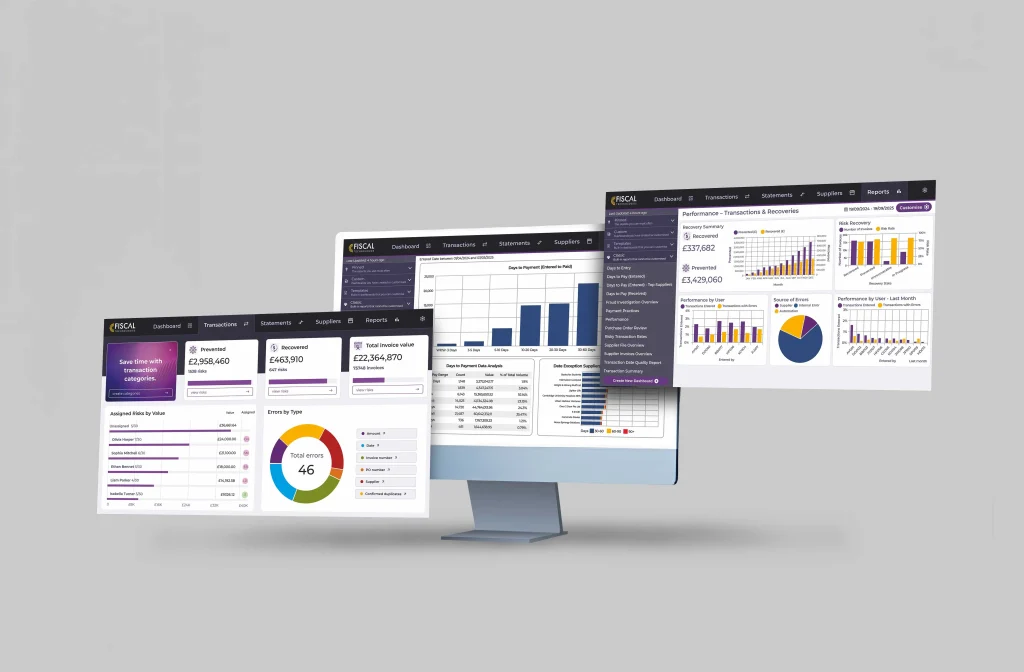
FISCAL’s P2P risk management software helps finance teams protect spend through intelligent analysis. It analyses every supplier and invoice, finding risks for your team to investigate and resolve. It augments your team’s capabilities, strengthening controls before and after payment. It identifies duplicate invoices across both systems even when supplier names, invoice numbers, or amounts vary. It also catches suspicious activity during the vulnerable transition period. The software completes supplier file analysis to find supplier duplication and dormancy. It also tracks changes to the supplier file, monitors for supplier inclusion on sanctions and adverse media lists, and monitors supplier credit scores, indicating if there may be supply issues.
Going beyond the transition with ongoing spend protection
Superior risk controls aren’t only for times of change. Keeping it in place ensures continuous spend protection. You prevent fraud and overpayments before they happen, reducing spend on recovery and optimising working capital. Clean data directly increases efficiency, allowing you to optimise your processes.
Conclusion
M&A success depends on operational excellence during the transition – and nowhere is this more critical than in finance. The risks of duplicate payments, fraud exposure, data integrity issues, and compliance gaps are high, but they’re manageable with the right approach. Systematic controls, intelligent analysis, and your team’s expertise can combine to protect spend during your most vulnerable period. The cost of prevention is always less than the cost of recovery. And during M&A, when you’re already investing significantly, protecting spend is non-negotiable.
Ready to protect your spend during your M&A transition?
Learn more about how FISCAL’s P2P risk management software provides the systematic controls and intelligent analysis your team needs to maintain operational control through transformation.