 Transaction risk intelligence
 Automated supplier statement reconciliation
 Supplier risk intelligence
 Managed AP recovery audit
 Supplier file performance review
 Forensic risk analysis
 Consulting and bespoke reporting











Your organisations’ finance liabilities
Financial liabilities are part and parcel of an organisation. Loans, supplier payments, utilities and so on are obligations taken on to run the organisation and need to be paid.
While these monies are still owed to other parties, there can be a great deal of uncertainty. Take supplier payments. In some cases, suppliers might offer rewards for early payment, and penalties for late payments. Therefore, until it is paid you can’t be certain whether it will incur a cost, be paid on time with no difference in cost, or be reduced. Effectively, the time at which you pay suppliers reflects in your working capital.
For you, financial accuracy is non-negotiable. It’s imperative that ledgers are precise so you can report and plan with confidence. And with auditors on the lookout for liability position accuracy, it’s not something you would easily let slip. So, for known liabilities, you’ve carefully planned when and how to deal with them. In our example, you will have planned carefully how to deal with payments from suppliers and have controls in place to ensure a steady cash flow in this regard. However, the issue is in the unknown, the nasty surprise of a missing invoice and the resulting bottom line and supplier relationship impact of an unforeseen late payment.
Unknown liabilities in finance and what to do about them
Liability visibility is key for all organisations, otherwise, how can we know exactly what will be leaving the organisation and plan accordingly. Therefore, goods received not invoiced is not something you do not want to see. It represents an unknown issue and a future uncertainty regarding cash flow. These missing invoices are something you will want to investigate as soon as possible to minimise the impact they may have on ledger accuracy and working capital.
So, how can you increase transparency and control of your liabilities?
Using statement rec to create liability visibility
First (and we know you’ve heard this one before), you don’t know what you don’t know. And the simplest answer to find that information out is to ensure your controls are second to none. We’ve found that the most effective way to find missing invoices is to complete statement reconciliation with speed and precision.
Now, we know that manual reconciliations do not spell precision, and they most certainly aren’t fast. However, automated statement reconciliation can be exceptionally fast and accurate. We’re talking about a system that completes most of the process, including retrieving statements and ERP data, validating and matching, and identifying discrepancies. From there, your team can easily see where there are missing invoices and prioritise them accordingly.
In automating this process, you can reconcile all your statements, finding every issue and therefore greatly increasing accuracy and decreasing unknown liabilities at the same time.
With timely regular statement reconciliation, you can minimise Goods Received Not Invoiced (GRNI) surprises and ensure there is no build-up of unpaid invoices. In turn, that should mean a more stable working capital, with no large, unplanned payments leaving the business.
Alongside this, you can also identify opportunities for cash recovery. Statements also may contain unclaimed credits and duplicate payments. Did you know that most organisations only find about 5% of their unclaimed credits? However, in their top 250 suppliers, where there are discrepancies, FISCAL’s customers usually find £240k of unclaimed credits per year. Think how much you could find if you reconciled every single statement you receive.
Using reports to shine a light on liabilities
For proactive, go-getting finance teams, identifying the root cause of those missing invoices and other discrepancies found during statement reconciliations is your next step.
Ensure your team record the discrepancy as thoroughly as possible when competing reconciliations, and how they were able to solve it.
After a set of statement reconciliations have been completed, look through the logs and audit trails for the discrepancies and find any items that come up time and again.
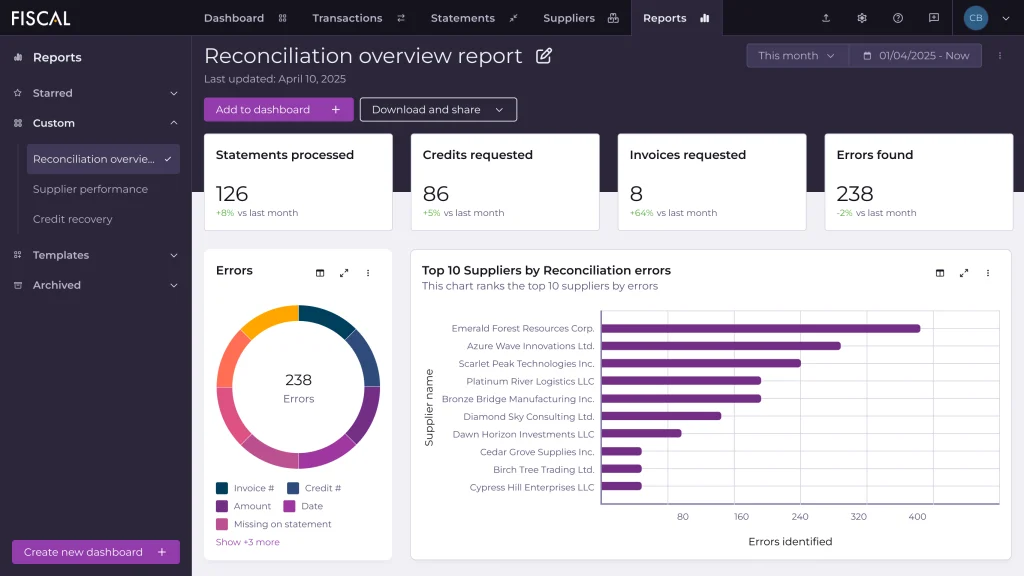
It’s here that reports are extremely useful. By using reports and cross-referencing information, you may be able to pinpoint information to help you streamline and improve processes.
For example, some suppliers may have a higher number of discrepancies. You can then cross reference by the person responsible for those transactions during that period, by how the invoice was received, who completed the PO, etc. Once you understand the issue, you will be better equipped to address it. A compliance issue may result in stricter controls and spot checks for example.
Automated Statement Reconciliation with FISCAL
Our software automates your supplier statement reconciliation:
- Save time with up to 12x faster statement reconciliation.
- Investigate and act on errors, fast.
- Understand problem suppliers and reduce future issues through reports.
- Batch processing capabilities for working at scale.
- Rapidly process all types of supplier statement.
- Discover credit notes, rebates, discounts, duplicate statements and previous overpayments.
- Export the results back to your supplier.
Statement reconciliation isn’t a nice to have – it’s a necessary control for optimum accuracy and oversight. Keep on top of liabilities for good.