 Transaction risk intelligence
 Automated supplier statement reconciliation
 Supplier risk intelligence
 Managed AP recovery audit
 Supplier file performance review
 Forensic risk analysis
 Consulting and bespoke reporting











This blog walks through the controls that keep your spend safe before, during and after the move, and where to focus so you’re on track for the mandate live date.
Why migration is the danger window
Duplicate and erroneous payments are a steady drain on spend even in usual conditions. APQC’s benchmarking puts the median organisation’s duplicate or erroneous payments at around 1.5% of total annual disbursements. On £100 million of spend, that’s £1.5 million leaving the business.
But there’s no period when an organisation is more exposed to incorrect payments than during an ERP migration:
- Your team’s attention shifts to the project, leaving little time for spot checks and routine processing checks.
- Until user roles and permissions are rebuilt in the new system, segregation of duties may not be enforced — which opens the door to error and internal fraud.
- Confusion during the shift may cause suppliers to submit invoices twice, or your team to duplicate payments by accident.
Then there’s the data you’re carrying over – duplicates, dormant suppliers, incorrect supplier data. One FISCAL customer found that 70% of the records in their vendor master file were duplicate or inactive. That’s not unusual: Across our data, the median organisation has around half of its active supplier records sitting dormant. Copy that straight into a new ERP and you’ve moved every one of those risks with it.
What “getting it wrong” costs
The clearest cautionary tale is National Grid. In 2012, three years into an SAP implementation that had already slipped repeatedly, the team faced a go-live date of 5 November. The system wasn’t ready. Postponing meant tens of millions in overruns. They went live anyway.
The fallout was severe. The company spent $8 million on overpayments it never recovered, and paid out a further $12 million for short-pays and inaccurate deductions. More than 15,000 vendor invoices couldn’t be processed. Book-close time jumped from four days to 43, costing short-term borrowing opportunities the business relied on. Stabilisation took two years and a total of $585 million.
Unfortunately, the overpayments were a real problem. Once the wrong payment leaves, getting it back depends on the supplier, and sometimes, it’s just not possible to recover. Which is the whole argument for controlling spend before the pay run, and cleansing data before the migration.
The controls that keep your spend safe through ERP migration
There are three phases you need for thorough control throughout a migration:
1. Clean your supplier data before you move it
Before you move any data over:
- Run a forensic analysis of your existing supplier and transaction data. This uncovers historical overpayments you can recover (generating cash to help fund the project) and shows you exactly how clean, or messy, your data really is.
- Cleanse the supplier file. Merge duplicates, deactivate dormant accounts, and correct incomplete records. Anything you leave in place, you’re choosing to keep.
- Investigate, map and fix broken processes. Bottlenecks and error hotspots will be replicated in the new system if you don’t iron them out first.
How FISCAL helps:
Supplier risk intelligence detects dormant and duplicate suppliers and incorrect data, and checks suppliers against credit, sanctions and adverse media sources. The software surfaces the risks, you keep control of the calls.
2. Keep watch through the cutover
When data is moving and both systems may be live, risk is high. This is when duplicate invoices slip through parallel systems and controls sit in limbo.
- Keep continuous, automated checks running on transactions and supplier data throughout the transition (during, and after), to flag duplicates, suspicious activity and data discrepancies before the payment run and prevent overpayments.
- Back up your ledger regularly so you have a full, current copy if data is lost or corrupted in transit.
- Watch for supplier file changes. A migration is a convenient moment for a fraudster to alter bank details or push through a new account, so any change to the supplier master deserves a second look.
How FISCAL helps:
Transaction risk intelligence analyses every transaction in your ERP, so exceptions surface while you can still act on them, and before the money moves.
3. Benchmark and monitor after go-live
The job isn’t done at go-live – strong controls still need to be in place to protect your organisational spend and keep up compliance.
- Measure your key payment and processing metrics before and after migration. Without the “before” figure, it’s easy to see the new system through rose-tinted glasses. If the numbers aren’t the same or better, something needs fixing. Ensure your team keep thorough records of where processes are incorrect so you can amalgamate them later.
- Keep continuous monitoring in place. The controls that protect you through the move are the same ones that protect your spend every day afterwards. Superior control isn’t only for times of change.
How FISCAL helps:
Custom reporting makes tracking metrics and creating new reports simple, with pre-built reports and a gen AI report builder. Find trends, drive informed decision-making and process improvement, and share it all easily with the team.
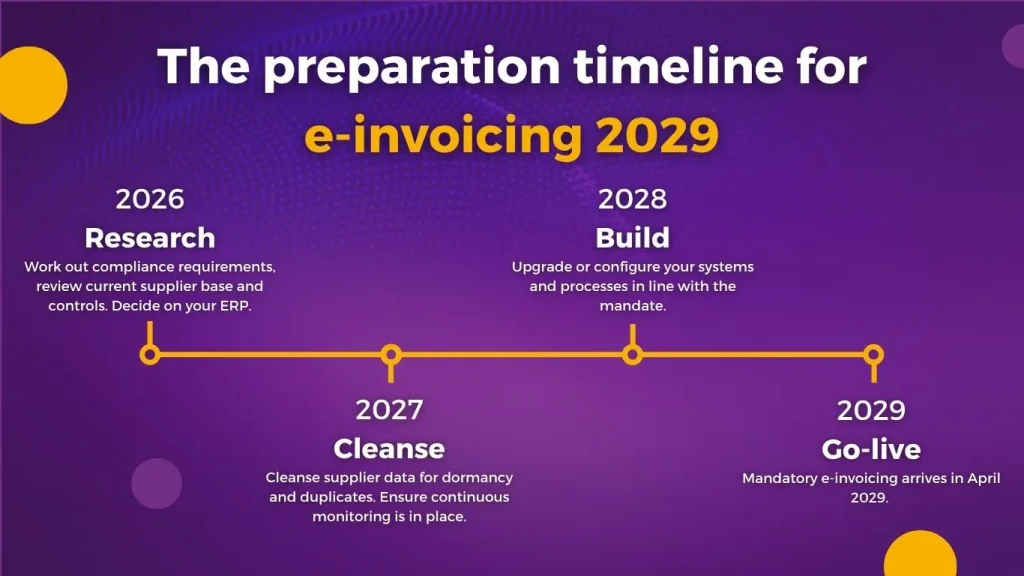
Your path to 2029
The mandate isn’t here yet, which is exactly why now is the time to prepare. We recommend a phased approach – to research, cleanse your data, and build your solutions in good time for the e-invoicing mandate go-live.
- 2026 — Research. Work out what compliance requires, review your current supplier base and the controls around it, and decide on your ERP.
- 2027 — Cleanse. Get your supplier data into shape ahead of the move, and put continuous monitoring in place so payment and supplier data accuracy holds through the transition.
- 2028 — Build. Upgrade or configure your systems and processes in line with the mandate.
- 2029 — Go live. Mandatory e-invoicing arrives in April 2029. If the groundwork is already done, it no longer becomes a scramble to this finish line.
The teams that come through a migration with their spend intact are the ones that treat data quality and payment controls as part of the project. When you get those right, you come out the other side of e-invoicing changes and migration with the ledger accuracy and forecasting precision to continue making confident financial decisions.
How FISCAL can help
FISCAL’s AI-native P2P risk management software helps finance teams protect spend and strengthen controls before and after payment, backed by our expert consultancy.