 Transaction risk intelligence
 Automated supplier statement reconciliation
 Supplier risk intelligence
 Managed AP recovery audit
 Supplier file performance review
 Forensic risk analysis
 Consulting and bespoke reporting











Updated in December 2025
Statement reconciliation is extremely important for many reasons, but first, it’s designed to keep your ledgers accurate while highlighting potential issues or opportunity to recover cash through overpayments or unclaimed credits.
It’s therefore extremely useful to have completed the process before the auditors arrive. You can use the outcomes of statement reconciliation to accurately review cash flow and make precise forecasts.
This blog will highlight the value of efficient statement reconciliation and explore how to do this.
The tedium of statement reconciliation
Manual supplier statement reconciliation is, quite frankly, something nobody wants to do. The most common manual method takes endless hours of combing through statements with a highlighter, line by line. The task is slow-going, with an average statement taking 30 minutes. It’s also taxing – finding tiny errors like a decimal point in the wrong place, or an incorrect quantity, takes concentration. It’s difficult to keep that level of concentration up for hours. Unfortunately, that can lead to errors.
The cost of errors in statement reconciliation
Statement reconciliation is about finding errors, so it’s irritating to find that even after all that hard work, some are still overlooked. Errors in your ledgers can cause underpayments, overpayments, or payment delays. With industry data showing that 1 in 3 statements contain errors, even small reconciliation mistakes can accumulate into significant financial risk.
Moreover, these issues cause a ripple effect on supplier relationships, company reputation and financial reporting. With a crackdown on late payments upcoming, it’s important to keep your processes tight.
The benefits of efficient statement reconciliation
Efficiency isn’t just something being completed with speed. It’s done with precision and of high quality. It’s achieving maximum productivity with minimum resource wastage.
With statement reconciliation, efficiency looks like having most of your suppliers reconciled before the next month is out, or as soon as practical after a financial close. Further, it means having acted before your deadlines to rectify any statement errors or take any rebates or discounts into account. It allows for faster cost recovery and therefore increases cost savings.
An efficient process means your staff save time, and productivity increases. Your books are fully in order. You’ll be aware of more errors, and therefore have a higher overview for potential fraud occurrences. You can build stronger vendor relationships. The intelligence you gain can help your Chief Financial Officer with improved financial reporting, driving critical decision-making.
With statement reconciliation, efficiency looks like having most of your suppliers reconciled before the next month is out.
The solution: Automated statement reconciliation
The solution to your statement reconciliation efficiency problems is simple.
Software can reduce the laborious task of comparing statements and instead supplies a short actionable list of anomalies, so your team can be proactive.
With automation, organisations typically complete reconciliation up to 12× faster, cutting the effort from around 30 minutes per statement to just a few minutes.
Instead of wasting resources, your people are giving value to the business, preventing payment issues and improving supplier relationships. And most importantly, they save time.
FISCAL Technologies can do the statement matching for you to highlight the issues – those tiny needles in the haystack you’ve been searching for.
How it works
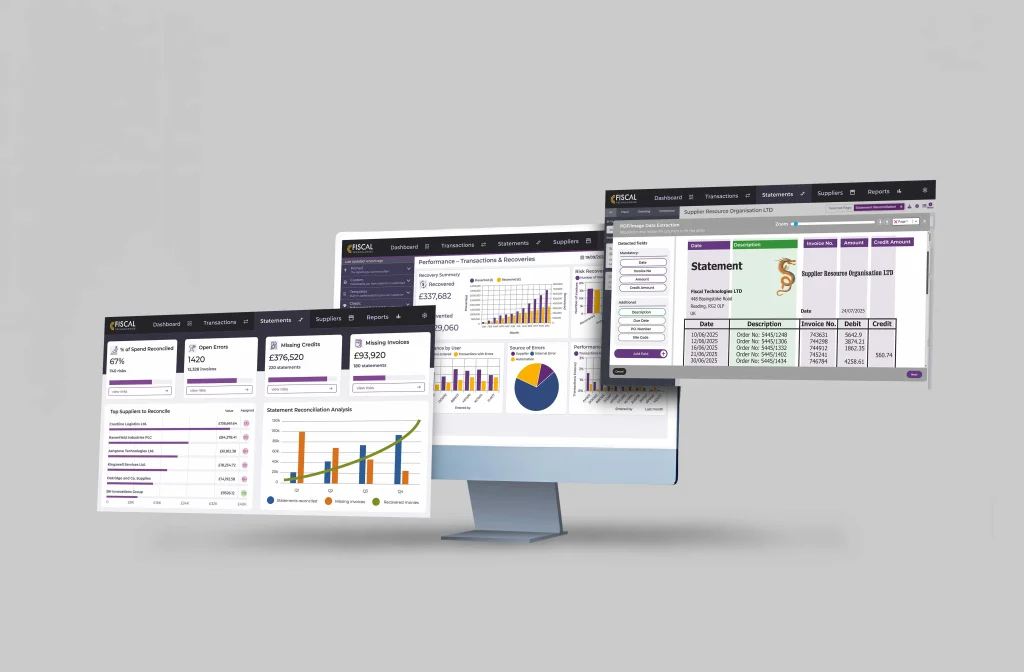
Our AI-driven statement reconciliation software compares each of your statements in detail to your transactional records. The platform then highlights transactions which don’t match, allowing your team to easily investigate and resolve exceptions.
It is simple to use, with an intuitive interface allowing for automated bulk processing, increasing statement reconciliation efficiency by 12x. Although minimal training and set-up is needed, our team support and guide you through the implementation process, ensuring it goes as quickly and as smoothly as possible. We’re also here for you afterward in case you have any further questions.
Conclusion
To recap; efficient supplier statement reconciliation is important because it highlights potential issues with your transactions and gives you opportunities to recover cash from mistaken payments.
Rectifying those errors allows for more accurate ledgers, which in turn ensures Chief Financial Officers and Finance Managers can give precise reporting and forecasting. Automated statement reconciliation is hugely valuable, as it can help you reconcile more vendors, more often, allowing for fewer wasted resources and instead allowing you to see where you could be recovering money from overpayment, or finding value with missed rebates and discounts.